How AI Chatbots Are Replacing Level-1 Support in 2026
A practical playbook to ship a GPT-powered bot that actually resolves tickets — with evals, guardrails, and handoff flows.
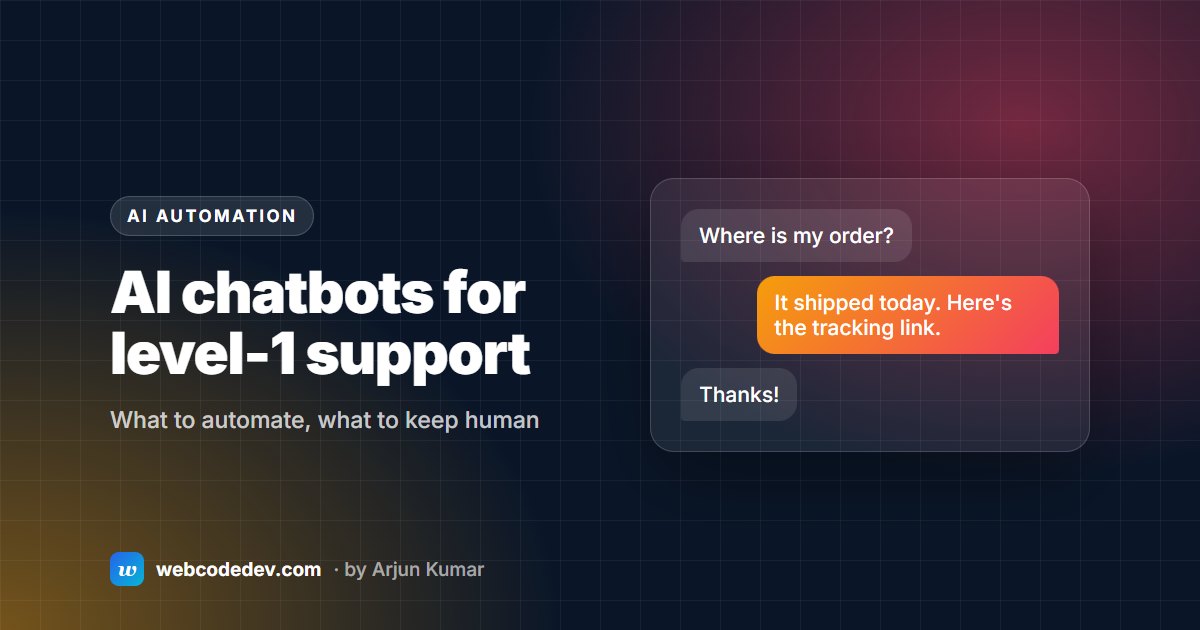
In 2026, AI chatbots have moved from novelty to core infrastructure. The best teams aren't just deploying chatbots — they're building support agents that resolve 70%+ of tickets, escalate intelligently, and get measurably better every week.
Why most chatbots fail
Most chatbot projects fail because they skip three things: a well-defined scope, a real evaluation suite, and a human handoff path. Without those, you get a chatbot that hallucinates, frustrates customers, and gets quietly disabled.
The architecture that works
We've shipped dozens of support bots and the architecture that consistently works looks like this:
- Ingest your help center, docs, and past tickets into a vector database.
- Retrieve the top-k relevant chunks using hybrid search (vector + keyword).
- Generate a response with strict system prompts and citation requirements.
- Evaluate every conversation against a golden set using an LLM-as-judge.
- Escalate to humans when confidence is low or sentiment turns negative.
Measuring what matters
The metrics we track on every engagement:
- Resolution rate — percentage of conversations closed without human touch
- CSAT — post-interaction rating
- Deflection cost savings — tickets avoided × agent cost
- Hallucination rate — sampled weekly
Teams that instrument these see compounding improvements. Teams that don't end up disabling the bot after a month.
What to build next
Once the basic bot works, the highest-leverage additions are usually: (1) proactive outreach on failed flows, (2) voice agents for phone support, and (3) internal copilots that draft responses for human agents.